

Landscape Scale Restoration Practices
These approaches may include steam restoration, reforestation programs, constructed wetlands and shoreline restoration. These approaches are often more complicated, and require cross-disciplinary teams that consider engineering, biology, and extensive local community engagement to succeed.
Stream Restoration
These projects can be technically complex, and require great care in selecting appropriate sites. They are highly visible and can be a community amenity, but only when done with early and meaningful community engagement. These projects can also be expensive, and require time for permitting and construction.

5 Things to Know About Stream Restoration
- Though expensive, improves health of aquatic resources, and when combined with upland restoration practices, is one of the more cost-effective practices to remove sediments and nutrients from urban watersheds
- Projects undergo extensive regulatory review and require state and federal permits
- There are many different approaches to stream restoration: natural channel design, regenerative stormwater conveyance, floodplain restoration, and outfall and gully stabilization – and combinations of the above!
- Can be a more controversial practice, especially without proper community engagement, often due to the need to remove trees
- Potential unintended environmental consequences need to be considered and mitigated in the design
Related Resources
View All ResourcesDeveloped by the Chesapeake Stormwater Network, this report (2020) provides updated guidance for crediting pollutant reductions from floodplain and stream...
Developed by the Chesapeake Stormwater Network, this report (updated 2020) refines guidance for applying the prevented sediment protocol to ensure...
This fact sheet covers the basics of Urban Stream Restoration including various approaches, verification and inspection, terminology, unintended consequences, and...
Reforestation/Riparian Buffers
Reforestation involves planting trees and native vegetation to improve watershed resilience and restore natural hydrology.
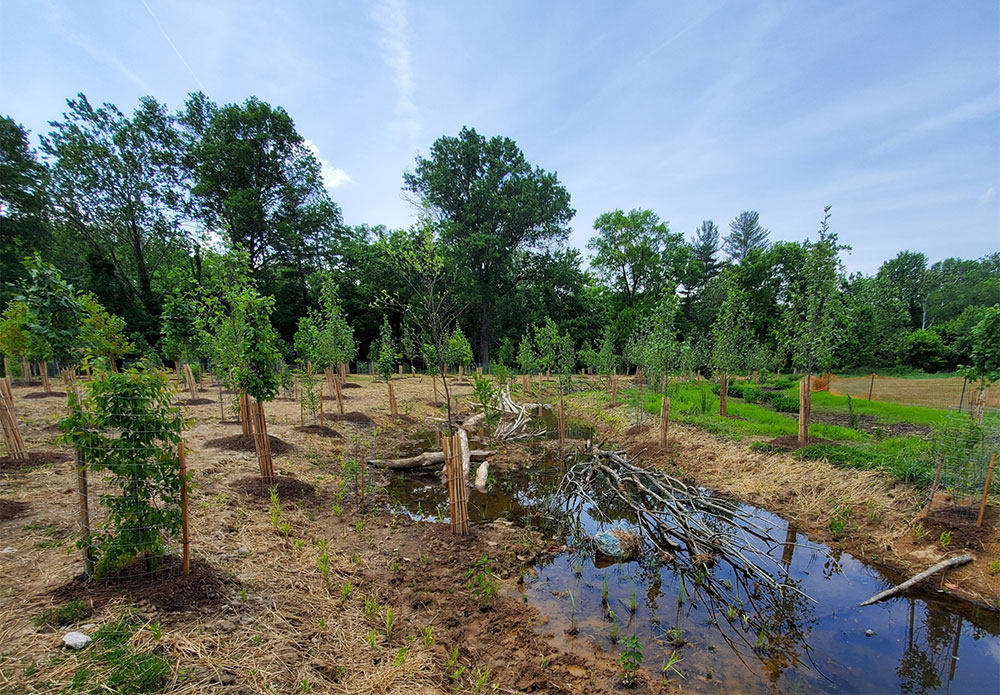
5 Things to Know about Reforestation/Riparian Buffers
- Can looks like several practices, including tree canopy expansion, street trees, forest planting or reforestation, and forest buffers
- Nutrient benefits can depend on whether the plantings convert turf or impervious land into tree canopy or forest
- Urban forest plantings are managed with no fertilizer and minimal mowing
- They provide a host of benefits beyond water quality improvement, such as better air quality, reduced urban heat islands, and wildlife habitat
- Tree plantings tend to be popular in most communities, and are a good opportunity to engage residents
Related Resources
View All ResourcesThis fact sheet covers the basics of Urban Tree Planting Practices, including definitions, general cost, tips for getting started, and...
This expert panel report (2014) evaluates updated research on nutrient and sediment removal by riparian forest and grass buffers to...
This expert panel report (2014) establishes pollutant removal crediting methods for urban filter strips, recommending runoff reduction and treatment-based load...
Constructed Wetlands
They provide excellent pollutant removal and habitat, but can be difficult to maintain long term.
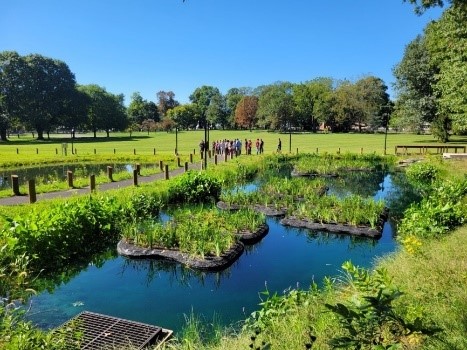
5 Things to Know about Constructed Wetlands
- Provide excellent pollutant removal
- Often seen in higher end developments and golf courses.
- Not a widely used practice, as they require a lot of land
- Need for deeper forebays and mirco-pools in order to manage sediment deposition
- It can be difficult to maintain the intended wetland plant community over the long term, due to invasive species such as phragmites.
Related Resources
View All ResourcesDeveloped by the Virginia Department of Conservation and Recreation, this design specification (Version 2.0, January 1, 2013) provides guidance on...
This fact sheet covers the basics of Floating Treatment Wetland practices, including general cost, reporting, verification, and computing the pollutant...
This report (2016), prepared by the Chesapeake Stormwater Network and the Chesapeake Research Consortium, establishes methods for estimating pollutant removal...
Shoreline Restoration
These projects restore natural water-land interfaces while providing a buffer against storms.
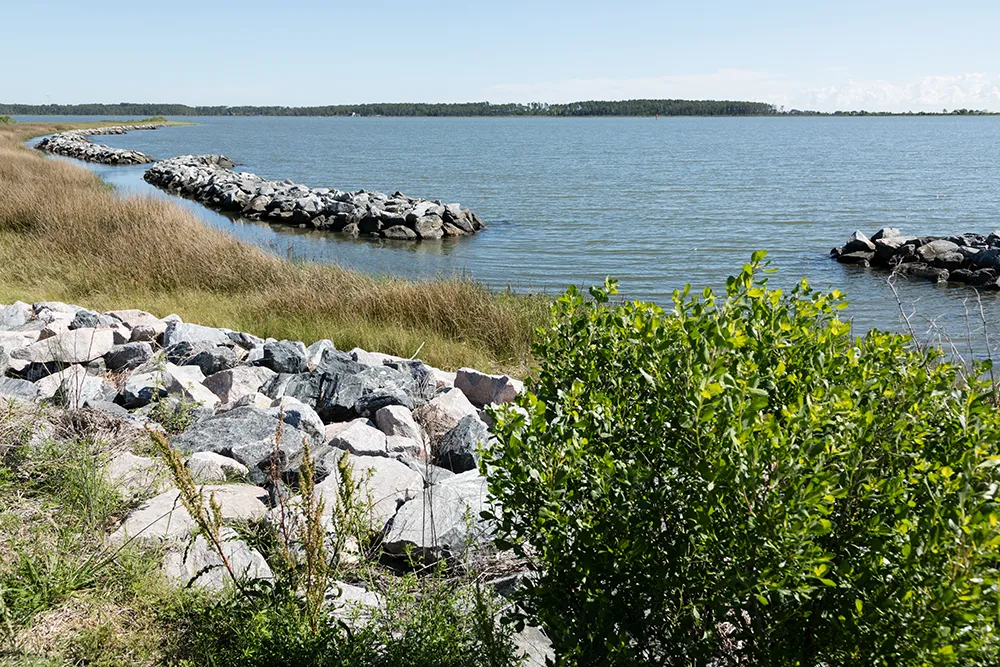
5 Things to Know about Shoreline Restoration
- This includes shoreline management practices, living shorelines, hybrid living shorelines, and structural shoreline practices (when living shorelines are not technically feasible)
- The type of shoreline management practice selected will vary based on local policies, site characteristics, owner preference, available funding, and multiple other factors.
- Prevents and/or reduces delivery of tidal sediments to the Bay from both bank and nearshore erosion
- There is no clear geographic boundary where shoreline management can be implemented, but practices are typically in tidal areas where erosion is most prevalent
- Can protect property and mitigate storm events including flooding
Related Resources
View All ResourcesThis fact sheet covers the basics of Shoreline Management Practices, including definitions, criteria, and computing the pollutant removal credit.
This expert panel report (amended 2019) develops Chesapeake Bay Program crediting protocols for shoreline management practices, establishing methods to estimate...