

Uncategorized
Grass Channel Design Specification
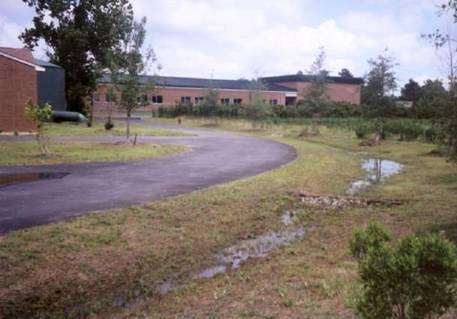
Ditches of Distinction: New Grass Channel Specification
[download id=”42
The grass channel has had a career trajectory much like the filter strip. First introduced in the late 1980’s, it had a brief surge of popularity, before disappearing as monitoring studies showed that dry and wet swales are more effective alternatives. Grass channels suffered the indignity of being demoted as major league practice to a minor league stormwater credit in the 2000 Maryland stormwater manual. In the Pacific Northwest, grass swales experienced a brief resurgence when they were re-branded as biofilters or bioswales, but they never really took off in most East Coast localities.
Still, grass channels can play a role in meeting runoff reduction targets in low density residential watersheds, when soils are suitable, or compost and/or checkdams are used to boost their performance.
Some of the key areas to take a close look are:
- Special applications: While dry swales are usually a preferred option, grass channels may be an appropriate option in karst and coastal plain terrain, as well as linear highway sites.
- Incorporating compost: Research has shown that grass itself is a fairly lousy filter; most of the real runoff reduction and pollutant removal is achieved by the soil. Most grass channels are graded during construction, however, compacting soils and diminishing their infiltration function. The trick to boost grass channel performance is to improve the quality of the soil underneath it. As a result, designers should strongly consider soil compost amendments during the construction process (see Baywide Design Specification No. 4). Compost amendments have a twin benefit: increasing soil infiltration and enhancing the vigor and density of the grass cover.
- Checkdams: The runoff reduction potential of grass channels can be increased when checkdams are installed. This spec provides some new guidelines and equations for calculating runoff volume behind checkdams (see the Appendix). I am not sure whether the sizing criteria in the body of specification are entirely consistent with the sizing equations in the Appendix (which I was happy to borrow from the NVRA LID manual). If a “slide rule kinda guy” could take a hard look at them, it would be helpful.
- Channel geometry: The geometry of a swale is extremely important to its future importance, so the spec provides some hard minimum standards for width, depth, slope and retention time.
- Construction inspection and acceptance: The spec tries to outline some measurable parameters to ensure they are installed right and still works properly after a few decent storms. This might involve measuring percent vegetative cover in the channel, checking the depth of compost incorporation and checking that the checkdams are installed properly. Still, the construction sequence and inspection section is a bit thin, so I would be grateful if anyone on the Network can provide better guidance.
Latest Resources
View All ResourcesDeveloped by the Virginia Department of Conservation and Recreation, this design specification (updated 2013) provides guidance on disconnecting rooftop runoff...
Developed by the Virginia Department of Conservation and Recreation, this design specification (Version 1.9, March 1, 2011) provides guidance on...
Developed by the Virginia Department of Environmental Quality, this design specification (Version 2, 2013) provides guidance on using grass channels...