

Design Specifications, Publications
Design Specification No 15: Extended Detention Pond
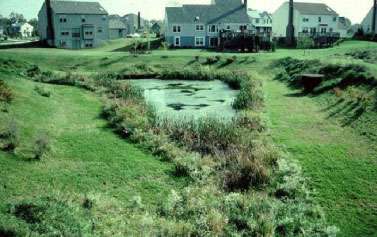
[download id=”3240″]
An Extended Detention (ED) Pond relies on 12 to 24 hour detention of stormwater runoff after each rain event. An under-sized outlet structure restricts stormwater flow so it backs up and is stored within the basin. The temporary ponding enables particulate pollutants to settle out and reduces the maximum peak discharge to the downstream channel, thereby reducing the effective shear stress on banks of the receiving stream. ED differs from stormwater detention, since it is designed to achieve a minimum drawdown time, rather than a maximum peak rate of flow (which is commonly used to design for peak discharge or flood control purposes and often detains flows for just a few minutes or hours). However, detention used for channel protection, may result in extended drawdown times. Therefore, designers are encouraged to evaluate the detention drawdown as compared to the ED requirements in order to meet both criteria. ED ponds rely on gravitational settling as their primary pollutant removal mechanism. Consequently, they generally provide fair-to-good removal for particulate pollutants, but low or negligible removal for soluble pollutants, such as nitrate and soluble phosphorus. The use of ED alone generally results in the lowest overall pollutant removal rate of any single stormwater treatment option. As a result, ED is normally combined with wet ponds (Design Specification No 14) or constructed wetlands (Design Specification No 13) to maximize pollutant removal rates.

Designers should note that an ED pond is the final element in the roof to stream runoff reduction sequence, so one should be considered only if there is remaining Treatment Volume or Channel Protection Volume to manage after all other upland runoff reduction practices have been considered and properly credited. Designers may need to submit documentation to the local plan review authority showing that all other runoff reduction opportunities have been exhausted and were found to be insufficient, leaving additional water quality or Channel Protection Volume to manage.
[download id=”3240″ template=”box”]
Latest Resources
View All ResourcesDeveloped by the Virginia Department of Conservation and Recreation, this design specification (updated 2013) provides guidance on disconnecting rooftop runoff...
Developed by the Virginia Department of Conservation and Recreation, this design specification (Version 1.9, March 1, 2011) provides guidance on...
Developed by the Virginia Department of Environmental Quality, this design specification (Version 2, 2013) provides guidance on using grass channels...