

Uncategorized
BUBBAs History Spotlight: Plum and Walnut St. Green Intersection (2014)
Some might say that the BUBBAs started at a crossroads.
Others who are less dramatically inclined might just say that the first ever
Best Urban BMP in the Bay Award went to a green street project at the
intersection of Plum and Walnut in Lancaster, Pennsylvania.
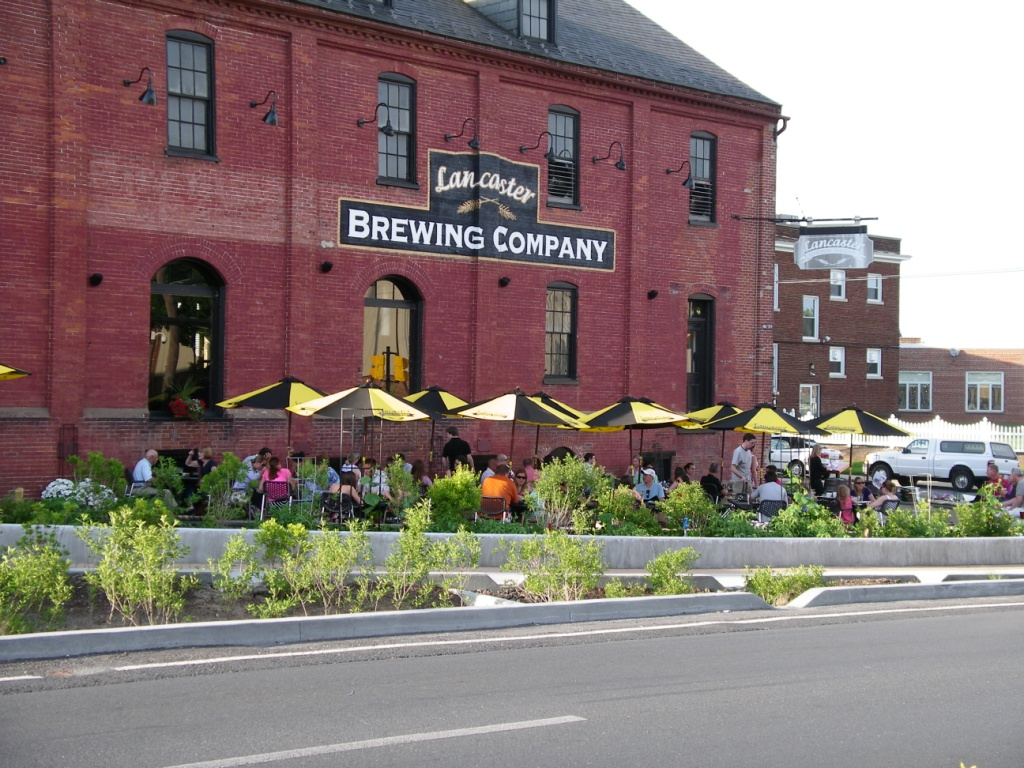
Located at the intersection of North Plum Street and East Walnut Street, the site of numerous vehicle accidents from a confusing merge lane, the Plum and Walnut Green Intersection Project integrated green infrastructure (GI), enhanced pedestrian amenities and a roadway realignment to improve traffic safety and reduce stormwater runoff.
The GI project included a series of BMPs including
bioretention, permeable pavers, infiltration beds, and tree plantings. The
combination of practices infiltrate, capture, and reuse rainfall, all while
providing an aesthetically pleasing amenity for local businesses near the
intersection. One of the happiest customers may be the neighboring micro-brewery,
who benefitted from a new outdoor café/seating area surrounded by native
plantings and an attractive curvilinear planter with a seatwall that divides
the public and private spaces. A combination cistern–public art amenity was also
incorporated into the overall project, capturing 700 gallons of stormwater from
the brewery’s roof to be used for watering plants. The cistern–art project was
constructed from stainless steel and native black locust wood and designed as
an urban version of a metal grain silo, paying homage to Lancaster’s agrarian
culture and the production of beer itself.
Traffic calming and pedestrian safety was accomplished by
constructing the vegetated curb extensions, new ADA ramps, crosswalks, and
signal upgrades. The curb extensions aid pedestrians crossing both streets by
narrowing the cartway width on these heavily trafficked roadways.
The impacts were realized immediately, as the project resulted
in a 5 mph reduction in traffic speeds through the busy, gateway intersection
into downtown Lancaster. The BMPs also prevent 1.4 million gallons of
stormwater runoff, 120 lb TNs and 50 lbs TP from entering the Conestoga River
every year.
Despite all its successes – it was awarded 1st
place in the “Best Ultra-Urban Project” category by the BUBBAs judges, then
named the Grand Prize winner of the inaugural contest by the People’s Choice
vote – the Plum and Walnut Green Intersection project did not rest on its
laurels. In the seven years since its completion, the City of Lancaster continues
to learn from, and improve upon the project. Among the initial challenges were
perfecting the planting palette and dealing with high sediment loads rushing
off adjacent surfaces and into the new bioretentions.
The initial planting palette consisted of grasses and winterberry that are native to Pennsylvania. However, the City quickly realized that the sandy soil media and high levels of road salt created conditions that those plants weren’t used to, resulting in high rates of die-off. Replanted in 2014, the bioretentions now include a mix of Mid-Atlantic native coastal grasses, planted tightly together and without mulch. The salt-tolerant plants are now thriving in the sandy, salty soils of a street-side bioretention.

The project also was plagued early-on by a deluge of
sediment-laden runoff from an adjacent alley. The stone cobble in the forebay
was quickly overwhelmed by sediment, creating a maintenance nightmare for the
City and potentially reducing the effectiveness of the BMPs. To solve the
problem, they decided to remove the stone cobbles in the forebay and replace them
with poured concrete and an energy dissipater. The new solution allowed maintenance
staff to more quickly identify sediment build-up in the forebay, and quickly
clean it out with a simple flat-edged shovel.
In some ways the Plum and Walnut Green Intersection project
exemplifies what the BUBBAs is about. It shows that even the best projects can
be learning experiences. We share our successes and our failures so that we fix
what we can and then build something better the next time. That is why, in the
5th year of the Best Urban BMP in the Bay Awards, no two contests
have been exactly the same. CSN is always striving to improve the BUBBAs, and
we hope 2021 will be the best yet.
Latest Resources
View All ResourcesDeveloped by the Virginia Department of Conservation and Recreation, this design specification (updated 2013) provides guidance on disconnecting rooftop runoff...
Developed by the Virginia Department of Conservation and Recreation, this design specification (Version 1.9, March 1, 2011) provides guidance on...
Developed by the Virginia Department of Environmental Quality, this design specification (Version 2, 2013) provides guidance on using grass channels...