

Award Winner, 2025
Doubled Joy – Residential Passive Stormwater Fountain
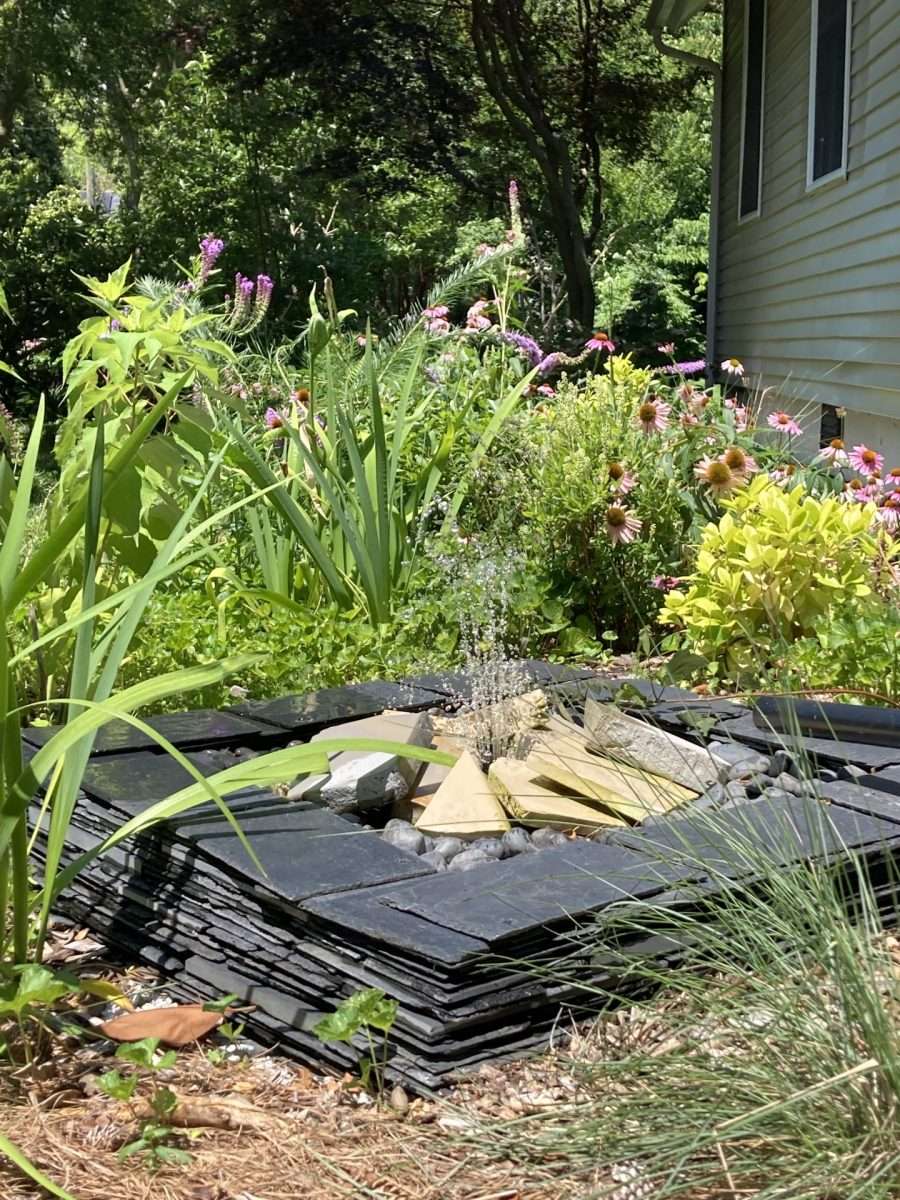
Kelly Morse, Fountain and Stormwater Berm Designer, Principal of 70|30 Design Studio
Mary Mantey, Landscape Designer, Elizabeth River Project
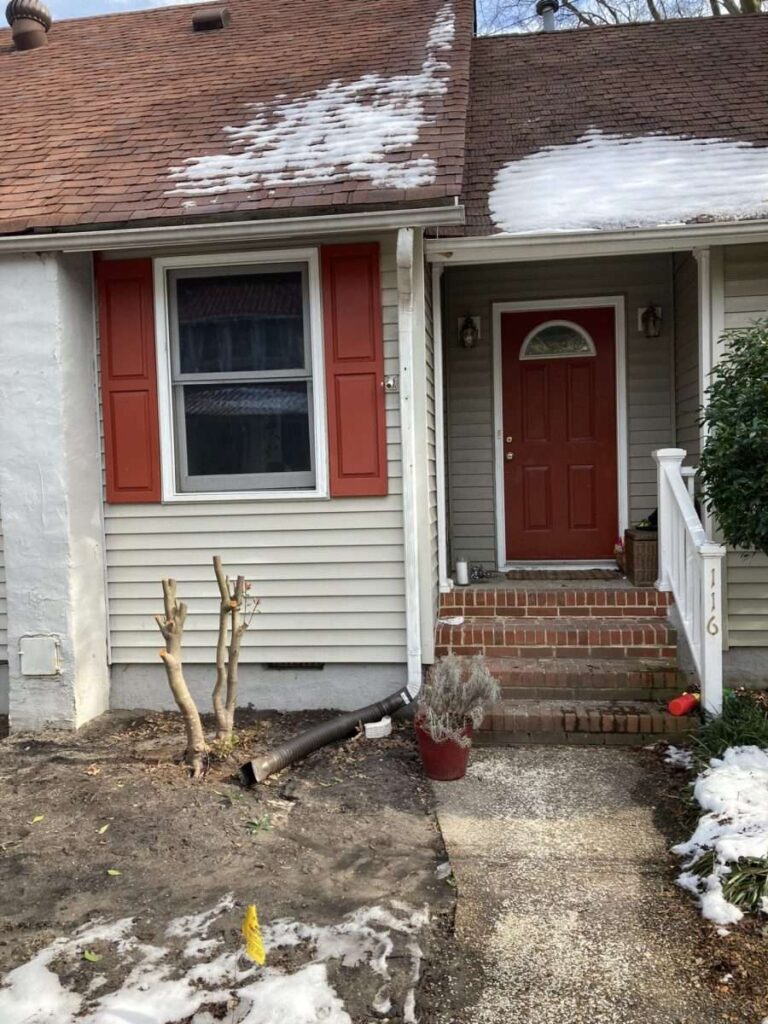
Redirecting stormwater into a fountain creates visual and sonic interest while also providing a water source plants and animals at this Norfolk, VA residence. Stormwater from a front stoop downspout had eroded both the house foundation’s slope and the front walkway’s base, leading to pooling. The homeowner, landscape designer Kelly Morse of 70|30 Design Studio, wanted to screen traffic noise and keep the water on the land – and away from the crawl space. Morse researched and designed a gravity-driven stormwater redirection process that includes a fountain and bioswale.
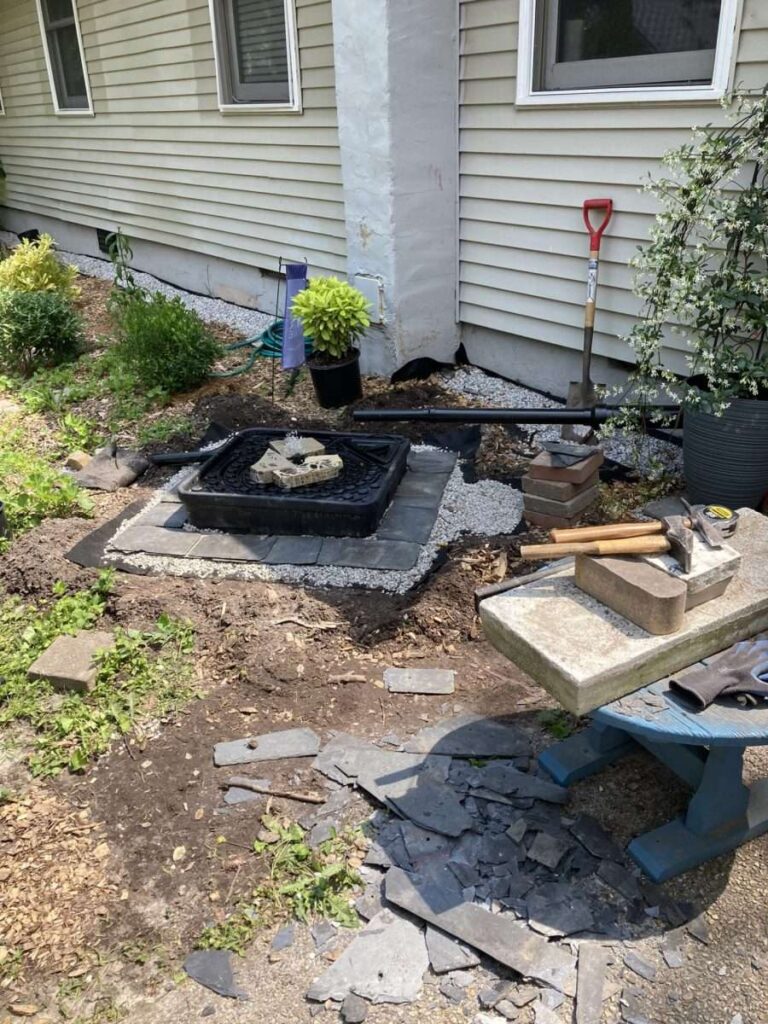
The average 200 gallons that comes down this downspout per 1.5” rainstorm now passes through a debris filter before being redirected into a 30 gallon reservoir set partially above ground. The fountain’s overflow pipe then releases extra water into a 25’ L x 2.5’ W x 3.5”D bioswale installed with native plants set 7’ away from the house’s foundation. One challenge was the common recommendation is raingarden should be 10’x10′” from landscapers and residential stormwater literature. These dimensions were not possible at the site. Morse contacted Fresh Coast Research Center, who used their HydroCAD system to calculate a long swale instead.
Plants were provided via a stormwater landscaping cost-share grant from the Elizabeth River Project. Reclaimed slateroof tiles edge the fountain, which doubles as skink and invertebrate habitat. Due to the swale, the front garden bed only needs to be watered during extended droughts. The fountain uses a small 350 GPM solar fountain, making it a 100% passive system. The overall cost of the project was less than $800. Morse participated in the Grow Native 757’s 2024 Garden Tour to share this innovative solution with her community.




Related Award Winners
View All Award Winners
The Belvoir Farms Restoration Project in Crownsville, Maryland, was initiated by the community’s desire to transition outdated 20th-century piped stormwater...
Since the implementation of the Chesapeake Bay TMDL municipalities learned that stream restoration is the most cost-effective best management practice...
Beginning in 2016, Fairfax County began benthic macroinvertebrate monitoring in the fall at five (5) locations as part of the...